The raising of Tabitha (Acts 9)
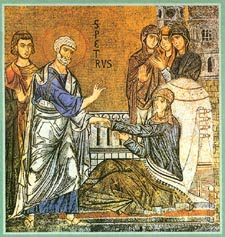 The lectionary readings for this week include iii substantial readings: Acts 9.36-43, Revelation 7.9-17 and John ten.22-thirty. At that place is a note which says: 'The reading from Acts must be used as either the starting time or second reading', which suggests that this reading is idea to be particularly of import.
The reading from Acts 9 comes at an interesting transition point in the narrative of Acts as a whole. In chapter vii, Stephen has become the first martyr for his faith, and the resulting persecution of Jesus' followers paradoxically leads to the further spread of the Word (Acts viii.4) including into Samaria, and nosotros read of Philip's meet with the Ethiopian court official ('eunuch'). This becomes the first stage of the spread of the practiced news across the bounds of or 'orthodox' Jews, and information technology anticipates the further rippling out that we encounter developing in Peter's run into with Cornelius in chapter 10. So in the beginning half of affiliate 9, Saul (Paul) encounters the risen Jesus on the road to Damascus, and we immediately see his powerful ministry in testifying to Jesus, initially to his fellow Jews. There is now a lull in the pressure, and in Acts 9.31 we come beyond one of Luke's summary statements (which we too find in Acts six.1, 12.24, 16.5 and 19.xx):
Then the church throughout Judea, Galilee and Samaria enjoyed a fourth dimension of peace and was strengthened. Living in the fearfulness of the Lord and encouraged by the Holy Spirit, it increased in numbers.
Luke here offers u.s.a. a picture of both trouble and triumph—the followers of Jesus under force per unit area and nevertheless seeing that God is sovereign, and that this skilful news will spread and alter the earth despite the opposition that comes.
But the change of focus from Peter to Paul and back again are function of Luke'south careful interweaving of the ministry of the two founding apostles, the one to the Jews and the other to the Gentiles. Paul'southward ministry will come to dominate the 2nd half of the book (though not without referring to Peter over again several times) and the ministry of Peter and Paul are advisedly balanced in the text:
| Peter | Paul | |
| 2.22 | Preaches most Jesus raised | xiii.26 |
| iii.1–10 | Heals a lame man | 14.8–12 |
| iv.8 | Speaks total of the Spirit | 13.9 |
| 5.fifteen | Extraordinary miracles | 19.12 |
| 8.17 | Laid on hands for Spirit | 19.6 |
| 8.18–24 | Rebukes opponent | 13.six–eleven |
| 9.36–41 | Raises dead person | 20.9–12 |
| 12.six–11 | Released from prison house | xvi.25–41 |
The story itself belongs in a pair with the much shorter account of Peter healing the paralytic Aeneas in the preceding verses (Acts ix.32–35); this is characteristic of Luke who distinctively offers us examples of male person-female pairs throughout the gospel and Acts. The language in that story has some obvious parallels with Jesus' healing of the paralytic inLuke five:17-26, with Peter using a similar control to 'take up your mat' (though the Greek grammar here is not quite the same).
Joppa was a prosperous port on the west coast of State of israel (modern day Jaffa nevertheless has an active fishing port) and was almost x miles from Lydda; Luke continues his practise of beingness precise nigh place names and distances. 'Tabitha' is an Aramaic name, and over again we come across evidence that Luke is writing with a Greek-speaking audition in mind, giving the translation of the name, which means 'deer'. He describes her equally a '[female person] disciple', the only time the feminine formmathetria occurs in the New Testament. This appears to suggest that she was of some standing in the Christian community; the note that she was ever 'helping the poor' and that her house had an 'upper room' (Acts 9.37) suggests that she was a woman of some means. There is, then, a development in this pair of stories; though both Aeneas and Tabitha are named (which is relatively unusual in ancient miracle stories, since the focus is on the one doing the healing rather than the ane healed), this second story is longer, more than detailed, and about a more significant person. Luke is in the habit of telling us about women of ways, both in Luke ('These women were helping to support them out of their own means', Luke 8.3) and in Acts ('One of those listening was a woman from the urban center of Thyatira named Lydia, a dealer in purple fabric', Acts xvi.14), and if his (real or narratively synthetic) benefactor Theophilus was also wealthy, that would be important. For Luke, the gospel is proficient news forboth poorand rich.
Washing the trunk of the deceased was normal Jewish practice, though there is no mention here of anointing. It is not surprising that there are widows waiting around, since they would both accept been beneficiaries of Tabitha'due south generosity and the ones who had washed the body, since this was the work of women. Peter shows none of the reluctance to come that he later on shows in the request from Cornelius, since this person is already a member of the Christian community and is a Jewess. The asking for Peter seems to assume the possibility of some miraculous restoration.
There are some obvious parallels in the narrative with the story both of the raising of the widow of Nain's son in Luke seven.xi–fifteen and the raising of Jairus' daughter in Luke 8.49–56. But these stories in turn accept echoes of the ministry of Elijah and Elisha (such as 1 Kings 17.17–24 and 2 Kings 4.32–37); Peter is not just continuing the ministry of Jesus, post-obit his example, but is as well continuing in a long line of prophets in Israel who practice a ministry building of miraculous healing. Luke is not content to relate the bare facts of the story; just as he puts compassion at the centre of stories of Jesus' healing, so he heightens the sense of pathos by describing the reaction of the mourners and their debt to the ministry of Tabitha, as they show the dress she has given (though we are not told whether these are garments they are currently wearing).
As Jesus has done, Peter sends the mourners out of the room; like Jesus, Peter uses a direct give-and-take of command; similar Jesus, Peter takes her by the hand; and like Jesus, he presents her back to her own. But unlike Jesus, Peter needs to pray to the 1 who gives healing; there is no doubtfulness here (as elsewhere) who the source of the healing is, and that Peter'due south ministry is entirely dependent on the power of Jesus. Luke doesn't have whatsoever qualms in noting that (again, in parallel to the ministry building of Jesus) the story becomes well known, and that (in parallel with the story of Aeneas), 'many' come to faith as a result. Only, in dissimilarity to contemporary stories of devil-may-care and insensitive prayer for healing, Peter has come in response to invitation, and the chief beneficiary is the person concerned. This is no performance in a circus of healing.
Despite the focus on the ministry of individuals in Acts, and particularly Peter and Paul, for Luke (as for all the biblical writers) the primary actor in the drama, the prime number subject of the narrative, is God himself—his sovereignty amongst his people, and the continuing ministry of Jesus carried out past the Spirit poured out on his people. Merely there is a strong sense in which Luke offers these stories as examples of the 'normal' Christian life; as Peter stands in continuity both with the prophets and with Jesus himself, we besides stand in continuity with him.
The reading from Rev 7 comes every bit office of the first interlude inside the sequences of the opening of the seven seals, coming between the sixth and 7th, and in some ways is offered as an answer to the question posed by those facing the wrath of the lamb 'Who can stand up…?" (Rev 6.17). Here are my introductory and last comments from my commentary on Revelation.
Context
We have already seen how the text of Revelation moves from ane scene to some other (quite contrasting) ane at key moments – the change from the epistolary introduction to the dramatic vision of the exalted Christ in Rev. i, the change of focus to the assemblies in Rev. 2–three, John's entry into heaven in Rev. 4 – 5, and the horsemen riding throughout the globe in Rev. 6. At the start of Rev. seven we have another change of focus and ethos, though this is all the same described from John's vantage point in the heavenly throne room.
We demand to read this affiliate in the context of what comes before and after, and in view of its connections with other parts of the book. This section of John'due south vision has 2 parts to it, related past the 'seeing versus hearing' motif we take encountered before: John 'hears' the number of those counted (just does not run into them); he so turns to 'see' an uncountable people, and these two descriptions interpret one some other. They both depict the 'servants of God' who are before his throne, and then this vision, as an interlude between the sixth and seventh seals, functions both to reply the specific question at the end of Rev. half-dozen 'Who can stand up?' But this interlude besides begins to address the larger question of God's volition for the globe and what he will do near humanity that has gone astray from his creation intention and both inflicts and suffers from anarchy, evil and death.
This section looks back to the throne scene, since we detect the 'keen multitude' are also before the throne, along with the living creatures, elders and angels, and they bring together in with the worship of the one seated on the throne and the lamb every bit the others take. But it also looks forward to the end of the book, anticipating the last scenes in the New Jerusalem, where they volition drink from springs of the h2o of life (7:17; 21:6) and 'God volition wipe away every tear from their center' (21:four).
Theology
The interlude in Rev. 7, between the opening of the sixth and seventh seals, is clearly continued with the preceding 6 seals, and both fills in details from a fresh perspective and answers the question posed at the stop of the sixth seal: 'Who tin can stand?' The four winds are closely connected with the 4 horseman, and the focus here is less on the destructive chaos that is unleashed and instead on God's human action of protection of those who take remained true-blue to him, using imagery from the devastation of Jerusalem that led to the exile.
John's vision here offers a three-fold motion picture of the people of God which are interrelated. The first is of a people looking like an army ready for spiritual warfare as they endure the intermediate fourth dimension between their release from slavery and before their entry into the promised land, recast by John to refer to the period from Jesus' death, resurrection and exaltation until his return and the renewal of all things. The second is of this people State of israel now drawn from all nations of the earth, 'out of every nation' in terms of having members from every nation rather than being a nation set apart past national and indigenous boundaries. They are a people caught up in the praise of the ane on the throne and of the lamb that we encountered in Rev. four – 5. The third portrait is of this people having come through intense suffering – non the suffering brought about past God's wrath and sentence, simply the 'tribulation' that comes from staying faithful to the testimony of the lamb who was slain in the face of relentless opposition. They are protected from divine judgement, but nonetheless endure suffering at the easily of human power; capacity 6 and vii together function as a narrative exposition of Jesus injunction in Matt. x:28. 'practice non fearfulness those who harm the torso, merely God who tin destroy the soul'.
Together, these portraits give u.s. a pic of a people in receipt of God'southward grace and responding to it. In contrast to those who, in agony, weep to the rocks and mountains for protection (6:16), the servants of God await for the souvenir of protection that comes from God'south sealing of them. They stand in white earlier the throne considering of the gift of the claret of the lamb, by which they take been purchased equally a kingdom of priests for God (5:9). And their response to this souvenir is to remain faithful, simply every bit Jesus did, and be ready to live a disciplined life of obedience. The holy warfare for which they are prepared is their not-violent witness to Jesus, even to the point of death.
If you lot enjoyed this, practise share information technology on social media, peradventure using the buttons on the left. Follow me on Twitter @psephizo.Similar my page on Facebook.
Much of my work is done on a freelance ground. If yous have valued this postal service, would you considerdonating £1.xx a calendar month to back up the product of this web log?
If you lot enjoyed this, do share it on social media (Facebook or Twitter) using the buttons on the left. Follow me on Twitter @psephizo. Like my page on Facebook.
Much of my work is done on a freelance footing. If you have valued this mail, y'all can make a single or repeat donation through PayPal:
Comments policy: Good comments that engage with the content of the post, and share in respectful debate, can add real value. Seek first to understand, then to exist understood. Make the almost charitable construal of the views of others and seek to learn from their perspectives. Don't view contend as a conflict to win; accost the argument rather than tackling the person.
Source: https://www.psephizo.com/biblical-studies/the-raising-of-tabitha-acts-9/
0 Response to "The raising of Tabitha (Acts 9)"
Post a Comment